



The Mechanisms, the Evidence, and the Financial Case for Speed
Light gauge steel shortens project delivery time by moving the majority of structural work off the critical path and into a controlled factory environment, where frames are manufactured in parallel with site groundworks rather than after them. The result, across a growing body of documented projects, is a schedule reduction that typically lands in the range of 30 to 50 percent against comparable concrete, masonry, or conventional stick-built programmes.
Light gauge steel and light gauge steel framing (LGS and LGSF) sit at the centre of the off-site construction shift that the McKinsey Global Institute has quantified: modular and off-site projects have consistently been completed 20 to 50 percent faster than traditional onsite builds. For developers, contractors, senior engineers, and the investors underwriting their pro-formas, that acceleration is not a marketing figure to be taken on faith. It is a claim that has to survive scrutiny. This article validates the 30 to 50 percent range against independent evidence, explains the mechanisms that produce it, and connects the compressed schedule to the financial outcomes that decision-owners actually price: earlier revenue, lower carrying costs, and greater delivery certainty.
Validating the 30–50% schedule-reduction range
The most authoritative anchor for the headline figure is the 2019 McKinsey Global Institute report on modular construction, which found that recent off-site projects have been delivered 20 to 50 percent faster than equivalent onsite builds, while cutting cost by up to 20 percent under the right conditions. Because light gauge steel is one of the dominant framing systems used in panelized and volumetric off-site production, this independently derived band is the credible basis for a 30 to 50 percent claim applied to well-executed LGS and LGSF projects. Represented honestly, 30 to 50 percent is the upper, well-executed portion of McKinsey’s wider 20 to 50 percent range, not an inflation of it.
Government strategy points the same way. The United Kingdom’s Construction 2025 programme set an explicit target of a 50 percent reduction in the time from inception to completion of new buildings and named light steel framing and volumetric construction among the technologies with the greatest potential to deliver it, as documented on the SCI/BCSA steelconstruction.info resource. Several suppliers claim reductions of 40 to 50 percent or more, and one certified light-steel system reports that pre-installed sheathing, insulation, and windows cut on-site construction time by up to 30 percent. These vendor figures are directionally consistent with the independent evidence, but they should be read as manufacturer claims rather than audited results.
McKinsey Global Institute, 2019: off-site and modular projects have consistently been completed 20–50 percent faster than traditional onsite builds, with LGS and LGSF among the principal framing systems used to achieve it.

Project evidence: measurable timelines, not marketing claims
Aggregate benchmarks establish that the reduction is plausible. Individual projects show it happening on real sites, with real schedules, against named conventional baselines. The pattern that emerges is consistent: the structural phase compresses from weeks per floor to days, and whole programmes shed months. The project case studies below are drawn from steel-industry sources and are self-reported by the stakeholders involved, so they are best read as specific, citable illustrations rather than independently audited trials.
| Project | Conventional Baseline | LGS Outcome | Documented Saving |
|---|---|---|---|
| 255 Colborne St, Brantford ON5-storey, 40-unit | Poured concrete / masonry | ~1 floor per week | 5–8 weeks faster; $100k earlier rent |
| Element by Weston, Chattanooga7-storey, 131-room | 3 weeks per floor (CMU block-and-plank) | 3 days per floor | ~3 months saved overall |
| Residential home, Wayanad, India2-storey | Local concrete practice | 3 months, 3 laborers | Beat the monsoon window |
| Hilton Garden Inn, Durham NC | Original concrete design | CFS superstructure | 80% bearing-weight cut |
The Brantford building is the clearest financial illustration. It’s cold-formed steel superstructure was assembled at roughly one floor per week, and the developer reported cutting the timeline by five to eight weeks and collecting an additional $100,000 in earlier rent. The SCI/BCSA separately estimate that time-related savings of this kind commonly amount to 3 to 5 percent of overall project value.
Why the schedule compresses: the mechanisms of acceleration
The speed advantage is structural, not incidental. It comes from a small number of well-understood mechanisms that each move work off the critical path, remove rework, or shrink the physical structure that has to be built. Understanding them matters, because it is what separates a defensible engineering claim from a slogan.
Parallelization: building the frame while the ground is still open
The single largest driver is parallel production. In conventional construction, trades proceed largely in sequence, so each phase waits on the one before it. With light gauge steel framing, frames and wall panels are manufactured off-site while groundworks and foundations proceed on-site at the same time. When the foundations are ready, the frames arrive in sequence and are erected quickly. McKinsey notes that the substructure phase itself is largely unchanged, but everything above it shifts off the critical path, which is precisely where the compression comes from. This is why panelized CFS wall systems reduced per-floor construction at the Chattanooga hotel from three weeks to three days: the components already existed when the crew needed them.
The practical consequence for a programme is that the sequence stops being additive and starts being concurrent. Two workstreams that once ran back-to-back now run side by side, and the schedule collapses toward the length of the longer stream rather than the sum of both. On a conventional site, the structural frame cannot begin until the substructure is complete and cured; on an LGS programme, that same frame is already taking shape in the factory during the weeks the foundations are being poured. The critical path is not merely shortened. It is re-drawn.
This concurrency compounds down the programme. Because panels arrive weathertight-ready and dimensionally exact, the trades that follow, cladding, mechanical and electrical first-fix, and internal fit-out, can be sequenced tightly behind the erection crew rather than waiting for a drying, settling, tolerance-checking structure to stabilize. The schedule stops absorbing the slack that conventional builds quietly budget for at every handover.
Weather independence and faster dry-in
Because 60 to 90 percent of modular and off-site work happens indoors, weather exposure on the critical path is sharply reduced, and the envelope reaches a weathertight state sooner so internal trades can start earlier. The exposure this removes is not trivial:
- Roughly 21 percent of construction delays worldwide are attributed to adverse weather, per WeatherWise by EHAB (2026).
- A systematic review of 3,207 studies published between 1972 and 2020 found that adverse weather delays 45 percent of construction projects worldwide, per Morris et al. (AFIT Scholar).
- Widespread weather events can impose a 20 to 30 percent schedule impact on affected projects, per Construction Industry Institute figures cited by ALICE Technologies.
A build that spends most of its structural effort under a factory roof simply carries far less of this risk on its critical path.
Dimensional precision and the elimination of rework
Cold-formed steel is dimensionally stable. It does not warp, shrink, or swell, and it is factory-produced to tight tolerances, so what appears on the drawings is what arrives on-site. That removes a large share of field cutting, errors, requests for information, and rework. The Construction Industry Institute finds that rework typically runs 5 to 15 percent of project cost, falling toward 2 to 3 percent with thorough BIM coordination. On one light-steel project, a 73-bedroom Ronald McDonald House, the modeling team reported eliminating requests for information entirely. When rework disappears, so does the hidden schedule buffer that conventional projects quietly carry to absorb it.
Lighter foundations and design-to-manufacturing continuity
Two further mechanisms shrink either the structure or the handoffs between design and fabrication:
- A cold-formed steel framing system can be up to 50 percent lighter than a comparable concrete system. On the Hilton Garden Inn in Durham, switching to CFS cut bearing weight by 80 percent versus the original concrete design, allowing a smaller, faster, and cheaper foundation.
- A 2025 peer-reviewed ASCE study of a BIM-to-CNC digital workflow for LGS measured an average 38 percent reduction in task durations, with roof construction 50 percent faster, an 11 percent gain in bill-of-quantity accuracy, and payback in under 11 months.
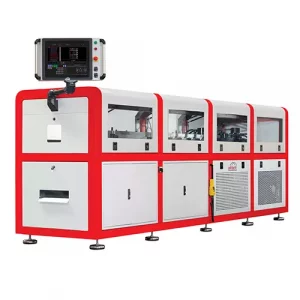
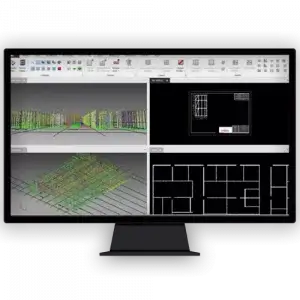
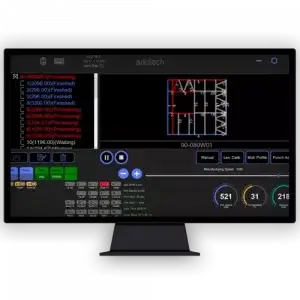
This digital continuity is the core of the modern LGS factory: engineering output becomes machine-readable production instructions with no manual re-drawing, so the friction between design and fabrication that slows conventional projects is designed out rather than managed. It is here, at the design-to-manufacturing seam, that software rather than material has become the decisive variable.

From schedule to balance sheet: the financial value of speed
For the developer, contractor, or investor, a compressed schedule is only interesting because of what it does to the numbers. Speed converts into money through several distinct channels, and a rigorous case names each one rather than gesturing at “efficiency.” The financial value of speed breaks down as follows.
- Earlier time-to-revenue. The Brantford developer collected an extra $100,000 in rent by taking occupancy sooner. For hotels, student housing, and rental assets, every month of earlier operation is direct revenue.
- Lower carrying and general-conditions costs. Shorter programmes reduce interim financing and interest, crane and scaffolding rental durations, and site supervision. The SCI/BCSA estimate time-related savings at 3 to 5 percent of overall project value.
- Reduced exposure to escalation. A compressed schedule shrinks the window in which input costs can rise. Construction material costs rose about 20 percent in 2023, with timber up to 50 percent higher in some regions after weather-driven supply shocks, per CMiC.
- Greater predictability. Factory production narrows schedule variance, giving lenders and investors more reliable delivery dates for pro-forma modeling and debt structuring.
Speed also eases the labor constraint that increasingly governs delivery. Prefabricated components reduce on-site labor requirements by 15 to 25 percent versus stick-built assemblies, a meaningful advantage given that, per McKinsey, the average number of U.S. construction vacancies almost doubled between 2017 and 2023. A method that needs fewer skilled trades on-site is not only faster; it is more resilient to the shortage that is slowing everyone else.
Where the advantage narrows
A credible case names its own limits. The 30 to 50 percent range assumes conditions that favour off-site production, and it compresses when those conditions are absent. The schedule advantage is smaller where a project lacks repetitive or standardized units, where a slender high-rise makes concrete’s mass structurally advantageous, or where the local LGS supply chain is immature. Cost savings, too, are less consistent than schedule savings across McKinsey’s dataset. Stating these boundaries plainly is what makes the headline figure trustworthy to the audience most likely to test it.
It is also worth separating the two claims that often travel together. Schedule savings are more consistent than cost savings across the evidence base. McKinsey’s own framing puts the cost reduction at up to 20 percent only when a project is done right, and construction-productivity statistics are contested on measurement grounds, so any productivity-gap framing should be attributed carefully rather than asserted. The schedule advantage, by contrast, is corroborated from independent, government, and peer-reviewed sources alike, which is why it is the safer foundation for a business case put in front of a skeptical lender or investment committee.
The through-line across every mechanism in this article is that the industry’s challenge has shifted. Proving that light gauge steel works is settled. The open problem is executing it with consistency, speed, and manufacturing precision at scale, and that is now a software problem as much as a material one. Integrating structural design directly with manufacturing, managing revisions without re-drawing, and turning a validated model into machine-ready output is precisely the seam where Arkitech positions its technology: closing the gap between what light gauge steel can deliver in principle and what it delivers on a live programme.
References
- Bertram, N., et al. — Modular Construction: From Projects to Products — McKinsey Global Institute, 2019 — https://www.mckinsey.com/capabilities/operations/our-insights/modular-construction-from-projects-to-products
- McKinsey & Company — Modular Construction: From Projects to Products (full report PDF), 2019 — https://www.mckinsey.com/~/media/mckinsey/business%20functions/operations/our%20insights/modular%20construction%20from%20projects%20to%20products%20new/modular-construction-from-projects-to-products-full-report-new.pdf
- Construction Dive — Modular Can Deliver Projects 50% Faster, McKinsey Finds, 2019 — https://www.constructiondive.com/news/modular-can-deliver-projects-50-faster-mckinsey-finds/557355/
- Mischke, J., et al. — Delivering on Construction Productivity Is No Longer Optional — McKinsey & Company, 2024 — https://www.mckinsey.com/capabilities/operations/our-insights/delivering-on-construction-productivity-is-no-longer-optional
- Mehdipoor, A., Iordanova, I., Al-Hussein, M. — Accelerating Light-Gauge Steel Construction: A Semi-Automated Digital Workflow (ASCE JCEM, 2025) — Modular Advantage — https://www.modular.org/2025/10/31/accelerating-light-gauge-steel-construction-a-semi-automated-digital-workflow-for-off-site-projects/
- Steel Framing Industry Association — Cold-Formed Steel Helps Owner Net an Extra $100,000 (255 Colborne Street) — https://sfia.memberclicks.net/assets/CaseStudies/colborne_rev1.pdf
- BuildSteel / SFIA — 5 Projects That Saved Thousands of Dollars With Cold-Formed Steel — https://buildsteel.org/projects/5-projects-saved-thousands-dollars-cold-formed-steel/
- BuildSteel / SFIA — Load-Bearing Steel Framing Speeds Hotel Construction, Saves 3 Months (Chattanooga) — https://buildsteel.org/projects/non-residential/load-bearing-steel-framing-speeds-hotel-construction/
- BuildSteel / SFIA — Steel Framing Saves 9 Months on Construction, Beats Monsoon Season (Wayanad) — https://buildsteel.org/projects/multi-family-residential/steel-framing-saves-9-months-construction-time/
- Steel Construction Institute (SCI) / BCSA — The Case for Steel — SteelConstruction.info — https://www.steelconstruction.info/The_case_for_steel
- SCI / BCSA — Construction and Demolition Waste (Construction 2025 target) — SteelConstruction.info — https://www.steelconstruction.info/Construction_and_demolition_waste
- The Steel Network — Hilton Garden Inn, Durham, NC (80% bearing-weight reduction) — https://steelnetwork.com/project/hilton-garden-inn-durham-nc/
- The Steel Network — 4 Ways to Save Time & Money Using BIM with Light Steel Framing — https://steelnetwork.com/4-ways-to-save-time-money-using-bim-with-light-steel-framing/
- Construction Industry Institute figures via Optimar Precon / Plannerly — What Is BIM in Construction? (rework 5–15% → 2–3%) — https://optimarprecon.com/what-is-bim-and-its-benefits/
- WeatherWise by EHAB — Construction Delay Statistics: Weather Impact Data 2026 — https://ehab.co/knowledge/construction-delay-statistics
- Morris et al. — Weather-Related Construction Delays in a Changing Climate: A Systematic Review — AFIT Scholar, 2021 — https://www.researchgate.net/publication/349893899_Weather-Related_Construction_Delays_in_a_Changing_Climate_A_Systematic_State-of-the-Art_Review
- ALICE Technologies (citing CII) — How to Calculate the True Cost of a Construction Delay — https://blog.alicetechnologies.com/how-to-calculate-the-true-cost-of-a-construction-delay
- CMiC — Construction Weather Risks and Project Control Strategies — https://cmicglobal.com/resources/article/extreme-weather-the-construction-industry
- Grand View Research — Light Gauge Steel Framing Market Size & Share Report, 2030 — https://www.grandviewresearch.com/industry-analysis/light-gauge-steel-framing-market
- Elsevier / ScienceDirect — Can LGSF Modular Housing Achieve Net Zero and Support the UK Social Housing Crisis? 2024 — https://www.sciencedirect.com/science/article/pii/S2352710224032819

 by
by